


In the symphony of Kenya’s musical heritage, one name reverberates with the fierce resonance of a drumbeat; one Catherine Muthoni, immortalized as Celina the woman who carved melodies into the soul of a nation. Born into a lineage where music coursed through their veins like a mighty river, Celina was destined to become more than an artist; she was a revolution. The younger sister of the legendary Maestro Joseph Kamaru, she inherited not just a voice but a legacy one that would propel her to the zenith of Kenya’s cultural awakening.
Their journey began not on stage, but huddled around a crackling radio in 1965 tuned to VoK, as Mwangi Wa Gacau’s ‘Mbeca Ithiragira Urakua’ pierced the static. Kamaru, turned to Celina: “We will outshine this.” A vow sealed in fire.
Few months later, and earlier of Celina, Kamaru entered the music industry. Celina, stepped into the spotlight as Kamaru’s backup vocalist in May 1965 debuting with ‘Uthoni Wa Mbathi-ini and Ndutige Kuhenia Igoti. together they formed Joseph Kamaru and Sister Band.

In an era when female voices were stifled by tradition, Celina’s harmonies soared above the cacophony of limitation. Her brother, the visionary Kamaru, had just severed ties with the British Polydor label and aimed at creating a homegrown record label that would accommodate upcoming artists.
Together, the siblings forged a label- Kenya United Sounds born in the fiery crucible of 1972 where the band also rebranded to the famous Kamaru Celina Band. Here, Celina was not just a partner but a pioneer, Kenya’s first female recording artist, a title etched in gold amid a male-dominated industry.
(Although having his own label Kamaru also recorded with other international labels for instance in his 1977 Kenya Kurungara Album was recorded and distributed under RCA’s banner an American record label)
Kamaru Celina’s music was not confined to vinyl. It reverberated in the halls of power. Celina and Kamaru became cultural diplomats, serenading Kenya’s founding father, Mzee Jomo Kenyatta, at state events. Among the audience a young Uhuru Kenyatta, barely 10, who would decades later reunite with Celina at Kamaru’s funeral. Laughter echoed as they reminisced the 1970s nolstagia where the band had created rapport with young Uhuru Kenyatta
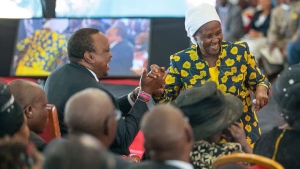
But as the crescendo of fame peaked, Celina chose a different melody. In a move that stunned fans, she traded spotlights for the quiet warmth of marriage, leaving the stage as abruptly as she had claimed it. The Kamaru-Celina era ended, but its echoes never faded with blockbusters like;
Uthoni Wa Mbathi-ini
Muceneneko
Muthumitie Airitu
KFA
Mundu Anyite Ndari Yake
Kindu Ki Murio
Na Ugatoroka
Njikirira Twa Meeri
Muti Uyu Mukuona
Kibata Kia Matuku Maya
Ndiratuire Njui
Mucií Nduri Kabúri…
On November 8, 2019, Celina took her final bow, yet her voice remains an iconic whisper in Kenya’s winds, a testament to the woman who dared to sing first, sing loudest, and sing unapologetically.
Her legacy?
Not merely in vinyl grooves or faded posters, but in every young girl who opens her mouth to roar. For Celina did not just make music; she forged nation a rhythm of resilience that pulses eternally in the heart of a nation.
Here’s A Montage Of Some Of Kamaru Celina’s best
https://youtu.be/JAuKsbK-Po8?si=ErQmfIqWZtaLEkp4


